
Greek And Roman Deities On Coins-15
2026-01-28 Wed
Poseidon, a prominent figure among the twelve Olympian deities in ancient Greek religion, is recognized as the god of the sea, storms, earthquakes, and Horses. According to Homer and Hesiod, Poseidon assumed the role of LORD of the sea following the overthrow of his #father, Cronus. When Poseidon and his brothers, Zeus and Hades, cast lots to divide the universe, Zeus secured dominion over the heavens, Poseidon claimed the sea, and Hades took charge of the underworld. In Roman #tradition, Poseidon is equated with the god Neptune.Poseidon is married to the sea nymph Amphitrite and is said to have resided in a magnificent palace beneath the sea. Their son was Triton, and to learn more about him click to this link: Greek And Roman Deities On Coins-4
Due to his capability to incite storms and earthquakes, Poseidon is often viewed as one of the most disruptive gods in the ancient Greek Pantheon. Nevertheless, he serves as a protector of seafarers and acts as a #guardian for numerous Hellenic cities and colonies.
In ancient Greek art, Poseidon is typically depicted as a mature, bearded figure. He frequently wields a trident, utilizing it to create seismic disturbances by striking the ground. Additionally, he is represented riding in a golden chariot drawn by hippocamps—mythical creatures that are half horse and half serpent—or by #GOLD-shoed horses. A variety of #marine #life, including dolphins, seahorses, and tuna fish, is often present around him.
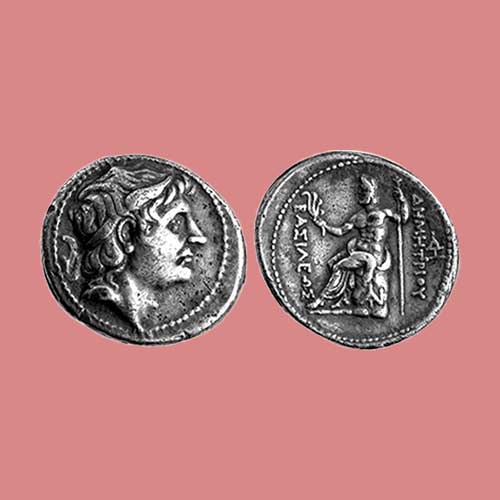
Poseidon began to appear on coinage during the 5th century BCE. The coin featured on this post is a Silver Tetradrachm from the reign of Demetrius I Poliorcetes, dated between 306 BCE and 283 BCE, originating from Pella, an ancient city in Macedonia, Greece, which served as the capital of the Kingdom of Macedon. Weighing 16.85 grams, the obverse displays a diademed head of Demetrius I facing right, complemented by a bull Horn. The reverse illustrates Poseidon seated on ROCKY terrain, holding an aphlaston, a symbol of naval supremacy in his right hand, while his left hand holds his #trident. There are two monograms present, one inscribed on the rocks and another at the extreme right of the coin, along with the Greek inscription "Basileos Demetriou," which translates to "of #King Demetrius."
Latest News
-
Extremely Rare Silver Quarter Tanka of Kachar Monarch Yasho Narayan, Owing Allegiance to Ghatotkacha Lineage
2026-06-23 TueHidden within the misty valleys and forested hills of Northeast India lies the story of the Kacha...
-
Gun and Sword on Silver Katra Taka of Independent Kingdom of Jaintiapur King Bar Gossain II
2026-06-22 MonThe Jaintia was a prominent medieval Independent Kingdom in Northeast India, ruled ...
-
Rare and Beautiful Gold Dinar of Gauda Ruler Shashanka
2026-06-19 FriThe Gauda dynasty was an ancient kingdom in the Gauda region of Bengal. It emerged as an independ...
-
Exceptional Gold Mohur of Ahom King Swargdeo Rajeshwar Singha
2026-06-19 FriThe Ahoms were ethnic group originating from the Tai people and founder of Assamese royal dynasty...
-
Heavy Lead Coin of Hiranyakas, King Khadakama
2026-06-18 ThuThe Hiranyakas were a local dynasty that rose in the mid-3rd century CE, in Rayalaseema region th...